Free MOT History Check & Vehicle Enquiry
Enter any UK registration for an instant MOT check — full test history, expiry dates, advisories, recorded mileage and tax status from official government records.
What Is an MOT History Check?
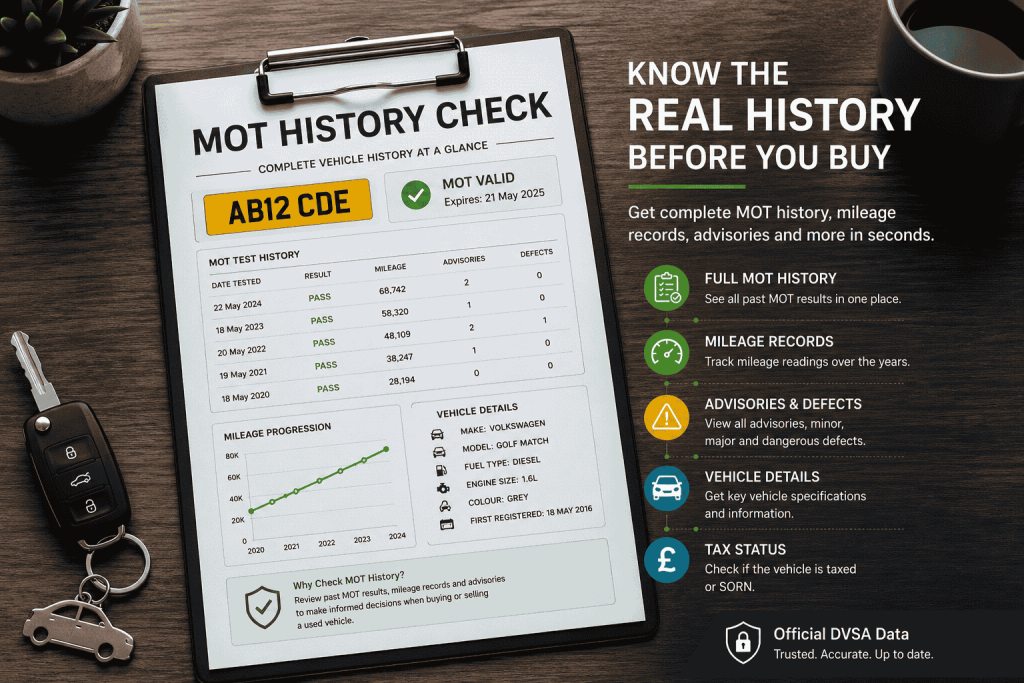
An MOT history check is a free online vehicle enquiry that retrieves the complete record of every MOT test a UK vehicle has been through since 2005, using only its number plate held by the Driver and Vehicle Standards Agency (DVSA). In addition to test results, it shows the recorded mileage at each test, any advisory notes left by the tester, the reasons for any failures, and the current MOT expiry date, defects identified during inspections. As a result, you get a clear picture of how the vehicle has actually been looked after over its lifetime, not just whether its current MOT is valid.
Unlike a standard MOT status check, which only confirms whether a vehicle currently has a valid MOT certificate, an MOT history check reveals the vehicle’s testing record across multiple years. This allows buyers and owners to identify recurring faults, repeated advisories, mileage inconsistencies, and long-term maintenance patterns that may not be obvious from a simple visual inspection.
Using our free MOT history checker, you can instantly access official MOT records, vehicle specifications, mileage history, tax status information, pass and fail results, advisory notices, dangerous defects, major defects, minor defects, recorded mileage readings, and test dates to help you make informed decisions before buying, selling, maintaining, or driving a vehicle.
Start your free MOT history check today by entering a UK registration number above.
Why Run a Free MOT History Check Before You Buy?
A used car can look immaculate on the forecourt and still hide years of mechanical neglect. Photographs never reveal worn brake pads, corroded suspension arms, or a tampered odometer. However, an MOT history check often does. According to DVSA MOT testing data analysed by the RAC, around a third of UK cars (roughly one in three) fail their MOT on the first attempt. Consequently, the chance that any given used car has had a difficult MOT history is genuinely significant.
Reviewing a vehicle’s MOT history before you commit to buying it reveals several things a seller has no legal duty to disclose:
- Recurring defects: Repeated failures or advisories on the same component (brakes, suspension, emissions) often signal an unresolved underlying fault.
- Mileage discrepancies: Every MOT records the odometer reading. A mileage that drops or stalls between tests is a clocking red flag that warrants walking away.
- Pattern of advisories: A long list of advisories that reappear test after test usually means recommended repairs have been deferred for years.
- Past dangerous defects: Serious safety issues recorded in earlier tests reveal problems the vehicle has had, even if subsequently repaired.
- Accident-damage clues: Repeated structural, body or steering geometry advisories can be early signs of past collision damage.
Furthermore, an MOT history check gives you genuine negotiating leverage. If the report shows three consecutive advisories on the suspension, for example, you have factual grounds to ask for a price reduction or to walk away entirely. As a result, the 30 seconds it takes to run the check often pays for itself many times over.
How to Run a Free MOT History Check in 3 Seconds:-
To run a free MOT history check on dvlamotcheck.com, simply enter the UK number plate into the search bar at the top of this page and press “Check MOT”. Within three seconds, you will see the full MOT history, current expiry date, mileage at each test, every advisory note, and the live DVLA tax status, all sourced directly from official government records.
The process is straightforward and works for any UK-registered car, van or motorcycle:
Step 1: Locate the registration number. Look at the front or rear number plate. UK registrations follow the format AB12 CDE, which means two letters, two numbers, then three letters. Spaces are optional because our tool formats the input automatically.
Step 2: Enter the registration. Type or paste the number plate into the search box at the top of this page. Either upper or lower case works fine.
Step 3: Press Check MOT. The tool queries the DVSA MOT history API and DVLA vehicle enquiry service in real time. Importantly, we do not store your searched registration against your IP address or device.
Step 4: Review the report. You will see the full MOT history laid out in chronological order, with test dates, results, mileages, advisories and failure reasons. In addition, the report shows the current MOT expiry, tax status, and the vehicle’s specifications.
Step 5: Share or print. Use the buttons on the results page to download a clean PDF or share the link. There is no limit on checks for genuine users.
The report provides a comprehensive overview of the vehicle’s testing history, allowing motorists to make informed decisions before buying, selling, or driving a vehicle.
What's Inside Every Free MOT History Report:-
Every free MOT history report on dvlamotcheck.com contains seven distinct sections, each pulled from the official DVSA and DVLA records. Together, they give you a complete picture of the vehicle’s testing history and current legal status.
Full MOT Test History from 2005 Onwards:
This is the heart of every MOT history check. The report shows every test the DVSA holds a record of, including the test date, pass or fail result, test number, the issuing test centre and the mileage at the time of inspection. Because MOT testing was digitised in Great Britain in 2005, records reliably go back that far for most vehicles still on the road today.
In addition, each test entry includes the full text of any tester comments. As a result, you can see exactly what the inspecting garage noted at the time, in their own words.
Pass and Fail Results with Reasons
Each test result is clearly marked as a pass or a fail. For failures, the report shows the specific reasons recorded by the tester, classified as either major or dangerous defects (or both). Consequently, you can immediately tell whether the vehicle has a history of serious mechanical issues or simply the occasional minor problem.
Recorded Mileage at Every Test (with Clocking Detector)
Every MOT test logs the odometer reading. Our report plots these readings in chronological order so you can see the mileage progression at a glance. Crucially, any drop or unrealistic stall between consecutive tests gets automatically flagged as a possible clocking indicator.
Clocking, which is the illegal practice of winding back an odometer to inflate a vehicle’s apparent value, remains a persistent problem in the UK used-car market. Although exact figures vary by source, industry estimates suggest a meaningful percentage of used cars on the market may have tampered odometers. The mileage timeline in your MOT history report is therefore one of the single most valuable consumer protections available, and it costs nothing to use.
Advisory and Defect Notes in Plain English
When a tester notices wear or potential issues that do not yet cause a failure, they record them as advisories. The exact tester comments appear in your report, with notes such as “brake pads close to limit”, “tyre worn close to legal limit of 1.6mm”, or “front suspension arm corroded but not excessively”. Each advisory is grouped per test and shown alongside the test date, so you can trace whether the same issue has been flagged repeatedly over multiple years.
Furthermore, advisories matter more than most buyers realise. If a suspension component is flagged as worn for three consecutive years and never repaired, the next MOT is very likely to fail on the same item. As a result, what looked like a deferred repair becomes an immediate one, often at significantly higher cost.
Current MOT Expiry Date and Countdown
The report displays the vehicle’s current MOT expiry date prominently, with a clear days-remaining counter. In addition, it colour-codes the status: green if the MOT is comfortably valid, amber if it expires within 30 days, and red if it has already expired. Therefore, you know at a glance whether the vehicle is currently legal to drive.
DVLA Tax Status:
Alongside the MOT data, your report shows the vehicle’s current tax status, the next tax due date, and any SORN (Statutory Off Road Notification) declarations. Because both MOT and tax come from the same query, you do not need to switch between two separate Gov.uk tools. In short, you get the full legal picture in one search.
Full Vehicle Specification:
Finally, the report includes the vehicle’s make, model, colour, fuel type, engine size in cc, CO₂ emissions, Euro emissions standard, and year of first registration. All of this comes from the V5C-linked DVLA dataset. Consequently, you can quickly check whether the seller’s description matches the official record, which is one of the most basic forms of fraud detection available.

How to Read an MOT History Report Like a Pro:-
A list of pass and fail results alone tells you very little. The real value of an MOT history check comes from spotting patterns. Below are the four signals experienced used-car buyers look for first, and what each one means in practice.
Pattern 1: Recurring Advisories on the Same Component
If the same advisory appears in three or more consecutive MOTs (for example, “front brake pads wearing close to limit”) without ever being repaired between tests, the previous owner has almost certainly been cutting corners on maintenance. Consequently, you should expect that component to fail soon and budget for the repair as part of your purchase price.
Pattern 2: Mileage That Drops or Stalls
A drop in recorded mileage between tests is, in most cases, physically impossible under normal use. Therefore, it is one of the strongest possible indicators of odometer tampering. Similarly, mileage that barely moves for two years and then jumps suddenly is suspicious. If you spot either pattern, the safest course is to walk away.
Pattern 3: Frequent Recent Failures
A car that has failed its last two or three MOTs, even if it eventually passed each time, is usually telling you something. Either the vehicle is suffering from age-related decline, or its owner is taking it to the test in a poor state of repair to “see what comes up”. Both scenarios suggest higher future maintenance costs.
Pattern 4: Long Gaps Between Tests
Periods where a vehicle has no MOT often correspond to SORN declarations (legally taken off the road) or long-term storage. Although this is not automatically a problem, you should ask the seller to explain the gap, especially if it overlaps with the year the car changed hands.
Understanding MOT Results:-
Many motorists simply check whether a vehicle passed or failed its most recent MOT. However, understanding the details behind the result often provides far greater value.
MOT Pass:
A pass means the vehicle met the minimum road safety and environmental standards required at the time of testing.
Although a pass is generally positive, it does not guarantee that the vehicle is free from wear or future maintenance requirements.
MOT Pass With Advisories:
A pass with advisories means the vehicle met the required standards but certain components showed signs of wear or deterioration.
Common advisories include:
- Worn tyres
- Brake wear
- Suspension deterioration
- Corrosion
- Exhaust wear
MOT Failure:
A failure indicates that defects were identified which prevented the vehicle from meeting legal standards.
Repairs must typically be completed before the vehicle can pass a subsequent MOT test.
Major Defects:
Major defects cause an MOT failure and require attention before the vehicle can be considered roadworthy.
Dangerous Defects:
Dangerous defects represent serious safety concerns.A vehicle with dangerous defects may be unsafe to drive and should be repaired immediately.
What Do MOT Advisories Mean?
Advisory notices are among the most valuable sections of an MOT history report.
Unlike pass or fail results, advisories often reveal developing issues long before they become serious enough to fail a test.
Common MOT advisories include:
- Tyres approaching the legal tread limit
- Brake pad wear
- Corroded suspension components
- Exhaust deterioration
- Steering wear
- Minor fluid leaks
A single advisory may not be concerning.
However, repeated advisories appearing across multiple years can indicate that maintenance recommendations have consistently been ignored.
When reviewing MOT history, recurring advisories should always be investigated carefully.
What Causes Most MOT Failures? DVSA Data Explained:-
According to published DVSA MOT testing data, the most common categories of MOT failure are remarkably consistent year on year. The pattern is worth knowing because it tells you what to inspect first when reviewing a used vehicle’s history.
The top causes of MOT failure in Great Britain, by category, are typically:
- Lighting and electrical equipment: roughly a quarter of all failures
- Suspension: around 19%
- Brakes: around 17%
- Tyres: around 12%
- Visibility issues (windscreen, wipers): around 9%
- Body, chassis and structure: around 6%
- Noise, emissions and leaks: around 5%
Source: DVSA MOT testing data for Great Britain; RAC analysis. Verify the current-year figures via the official Gov.uk MOT testing data publications.
The takeaway is straightforward: most MOT failures are entirely preventable. A bulb costs around £4. A 60-second check of all indicators, brake lights and number-plate lights before booking the test would prevent roughly a quarter of UK MOT failures by category. Tyre tread can be checked in under a minute with a 20p coin. Consequently, when you review a used vehicle’s MOT history and see repeated failures on bulbs or tyres, you are looking at evidence of neglected basic maintenance.
MOT History vs Service History: What's the Difference?
These two terms get confused often, and the distinction matters. An MOT history is a public record of every legal roadworthiness test the vehicle has been through, held by the DVSA. A service history, on the other hand, is a private record of voluntary maintenance work carried out by garages, typically recorded in a service booklet or digital service record.
The key practical differences:
- MOT history is public. Anyone with the registration number can view it free of charge on dvlamotcheck.com or Gov.uk.
- Service history is private. Only the registered keeper holds it, and a private seller may or may not produce it.
- MOT records only test results. It shows whether the vehicle met minimum legal standards on the test day.
- Service records show preventative maintenance. Oil changes, brake fluid replacements, cambelt changes and other voluntary work.
In short, the MOT history tells you whether the car is legal; the service history tells you whether it has been looked after. Ideally, you want both when buying used. However, if a seller cannot produce a service history, the MOT history becomes even more important, because it is your only objective record of the vehicle’s condition over time.
Why Use DVLA MOT Check For MOT History?
At dvlamotcheck.com, our goal is to make vehicle information easy to access and easy to understand.
Our free MOT history checker allows motorists to:
- Check MOT history instantly
- View historical MOT records
- Access recorded mileage information
- Review advisories and defects
- Verify vehicle tax status
- Check MOT expiry dates
- View key vehicle specifications
Whether you’re buying a used vehicle, monitoring your own car, managing a fleet, or simply checking a registration number, our service helps you access the information you need quickly and clearly.
Tips for Maintaining a Clean MOT History
A strong MOT history reflects a well-maintained vehicle. Follow these tips to ensure consistent MOT passes:
Regular Servicing: Schedule annual or bi-annual vehicle servicing to catch issues early.
Pre-MOT Checks: Inspect lights, tyres, brakes, and wipers before your test.
Address Advisories Promptly: Fix minor issues noted in previous tests to prevent failures.
Monitor Mileage: Keep accurate records to avoid discrepancies in MOT reports.
Use Trusted Garages: Choose DVSA-approved test centres for reliable inspections.
By staying proactive, you can maintain a clean MOT history and keep your vehicle roadworthy.
Start Checking Your MOT History Today
Don’t wait to uncover your vehicle’s MOT history. With DVLA MOT Check, you can ensure compliance, spot issues early, and make informed decisions. Enter your registration number now and get instant access to your MOT records.
Need help? Have a question about an MOT check or vehicle enquiry? Please contact us and we’ll be happy to assist.